
Intermittent Bonded Ribbon Production Line Available For Sale
With a listed operating speed of 600 m/min, this machinery offers substantial capacity for optical-fiber production. Prospective buyers should confirm the achievable speed, machine setup, and required operating conditions directly with the manufacturer before proceeding.
Shanghai Weiye OFC supplies equipment designed specifically for producing rollable ribbons containing 12 or 16 fibers. The published product information covers capabilities, technical details, and supplied systems, helping U.S. buyers begin evaluating the equipment against their manufacturing needs.
Review the listed configuration in the product description, then contact the supplier about pricing, installation, and options specific to your project. Doing so can clarify which specifications and options are relevant to your facility and production objectives.
Shanghai Weiye Optic Fiber Communication Equipment Co., Ltd. provides its business address as 201 Minyi Road, Songjiang District, Shanghai. Use the product page for initial reference and verify current technical and commercial information directly with the company. A detailed quotation request can help advance your equipment evaluation.
Intermittent Bonded Ribbon
SZ Stranding Line
Fiber Secondary Coating Line
Important Points To Consider
- A speed of 600 m/min is listed, but buyers should verify the operating conditions with the manufacturer.
- The machinery is intended to manufacture rollable ribbons containing 12 or 16 fibers.
- Information about equipment functions, specifications, and included systems appears on the product page.
- Request details about pricing, installation requirements, and project-specific customization.
- A company address in Shanghai’s Songjiang District is included in the supplier information.
Intermittent Bonded Ribbon Production Line Overview
The manufacturer identifies this machinery as suitable for 12- and 16-fiber rollable IBR formats. The published specifications state a 600 m/min construction speed together with a fiber diameter of Ф245 μm ±10 μm. As these are manufacturer-listed values, confirm the actual production speed and relevant operating requirements directly with the supplier.
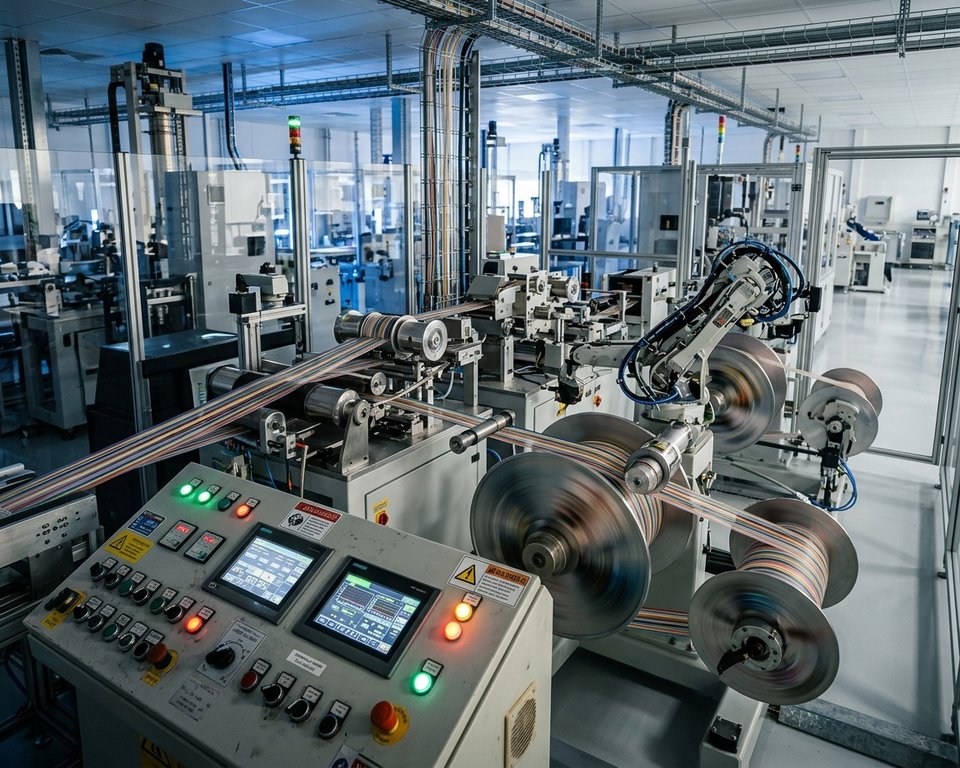 Intermittent Bonded Ribbon Production Line
Designed To Produce Twelve- And Sixteen-Fiber Rollable Ribbons
The machine configuration accommodates two different fiber counts in rollable ribbon designs. This provides a useful reference when buyers compare machinery against their required ribbon format, fiber dimensions, and material-handling arrangements.
How Intermittent Bonding Supports Flexible Fiber Arrangement
According to examples in the patent, fibers are arranged in adjacent subunits with adhesive connections applied periodically. One illustrated spacing range extends from 10 mm to 1,000 mm. Unlike continuous bonding, this arrangement does not join the fibers along their entire length.
These intermittent adhesive connections allow the assembly to change from a relatively flat configuration into rolled, curled, or folded forms. These bond-spacing figures describe examples of the design approach and should not be interpreted as stated equipment settings.
- Machine details: A choice of 12 or 16 fibers, a listed operating speed of 600 m/min, and a specified diameter of Ф245 μm ±10 μm.
- Patent example: Illustrative spacing between adhesive bonds of 10 mm to 1,000 mm.
- Design benefit: Adaptable handling when the ribbon takes different shapes.
Uses In Optical Fiber Cable Manufacturing
Flexible ribbon arrangements can help cable designers balance access for splicing with compact cable packaging. The patented design keeps fibers arranged in order while permitting sections between bonded points to shift as the cable is assembled.
Compact Cable Designs And High Fiber Density
An optical fiber ribbon may remain flat during mass fusion splicing and subsequently fold or roll for installation in a smaller cable. Potential advantages described in the patent include smaller cable constructions and an increased ratio of fiber area to overall cable cross-sectional area. The results achieved in practice depend on the complete cable construction and its intended use.
Organizing Fiber Ribbons To Support Efficient Fusion Splicing
The ribbon format enables organized handling at the splice location while allowing the subunits to move during cable assembly. The manufacturer’s material-handling specifications identify payoff reel capacities of 25.2 km and 50.4 km of fiber. Buyers can evaluate these capacities against their production requirements and existing handling arrangements.
| Design detail | Possible application | Consideration for buyers |
|---|---|---|
| Planar fiber arrangement | Fusion splicing of multiple fibers | Confirm requirements for the splice workflow |
| Ribbon configuration that folds or rolls | Space-efficient cable packaging | Review the overall cable construction |
| 25.2 km and 50.4 km capacity payoff reels | Planning material-handling operations | Match the reel capacity to production operations |
Specifications And Performance Of The Production Line
Before asking for pricing, assess whether the stated machine performance matches the demands of your production process. Installation preparations should also account for suitable reels and the utilities available at the production site.
Speed, Diameter, And Attenuation
The stated construction speed is 600 m/min. The specified fiber diameter is Ф245 μm ±10 μm, while additional attenuation is stated as ≤0.01 dB/km at 1550 nm. Confirm the measurement conditions and expected performance directly with the manufacturer.
Payoff And Take-Up Reel Compatibility
The payoff system accommodates two reel dimensions, and the maximum weight of a full reel is 10 kg. For take-up, the equipment accepts either a T-type reel or a fiber-optic reel. Check whether the preferred reel format suits your existing handling equipment and procedures.
Facility Utilities And Operating Environment
Plan for a 380 V ±10% power connection using a three-phase, five-wire system. The equipment should operate in an enclosed, clean, dry, draft-free area maintained at 15 to 25°C and a maximum relative humidity of 85%. Utility requirements also include nitrogen at 7 bar and 99.99% purity, plus a compressed-air supply at 6 bar. Verify the required utility connections before installation begins.
| Technical specification | Listed requirement | Planning note |
|---|---|---|
| Payoff reels | Ф236 × Ф25.4 × 108 mm; Ф267 × Ф25.4 × 180 mm; maximum full-reel weight ≤10 kg | Check reel compatibility and maximum weight |
| Reel used for take-up | T-type dimensions of Φ410 × Φ50.8 × 391 mm, or a fiber-optic reel | Confirm compatibility with your selected format |
| Power and environment | 380 V ±10%; 15 to 25°C; relative humidity ≤85% | Provide a clean, dry area without drafts |
| Gas supply | Nitrogen: 7 bar, 99.99% purity; air: 6 bar | Check available gas capacity before equipment setup |
Equipment For Fiber Payoff And Gathering
The payoff and gathering assemblies direct optical fibers into the ribbon-forming area. The associated controls help maintain a steady supply of fiber while reducing handling risks.
Tension-Controlled Payoff System For Sixteen Spools
The active payoff accommodates 16 spools, incorporates traversing, and permits independent tension adjustment. The permitted weight for an individual spool is up to 10 kg. The technical details list 0.4 to 2 N tension with ±0.02 N accuracy, together with a 550 W motor. Because a separate overview states 40 to 150 g with ±2 g accuracy, ask the manufacturer to clarify the correct values for your intended setup.
Fiber Guiding, Break Detection, And Electrostatic Control
The forming area receives fibers through U-groove guides, multi-groove gathering rollers, and devices designed to prevent jumping. A break-detection system and alarms notify operators when problems occur. Protective guards and pneumatic clamping provide additional support for safe material handling. At the fiber exit, a rod-style electrostatic dust collector is installed, while anti-static equipment helps manage dust along the gathering route.
| Equipment component | Specified details | Purpose |
|---|---|---|
| Payoff | 16 spools with a maximum of 10 kg each | Supplies fibers using traversing |
| Motor and tension system | Tension of 0.4 to 2 N, accuracy ±0.02 N; motor rated 550 W | Supports regulated payoff of fibers |
| Fiber guidance and safety features | Grooved rollers, alarms, guards, and pneumatic clamping | Guides fiber movement and assists material handling |
| Electrostatic management | Rod-type dust collector and anti-static equipment | Supports dust control along the fiber path |
Intermittent Adhesive Dispensing And Precision Molding
Operators can adjust adhesive positioning and mold alignment through the forming platform. Available adjustments help configure the process for each required ribbon format.
Adjustable IBR Mold Platform For Ribbon Formation
Three mold sets are provided for ribbon formation, and each accommodates as many as five Nordson EFD jet valves. Operators can position the mold within 0 to 15 mm and adjust its base temperature from 20°C to 60°C. Precision valve groups mounted on sliding tables allow fine positioning and accurate application of adhesive dots.
Configurable Nozzle Arrangements For Twelve- And Sixteen-Fiber Ribbons
For 12-fiber ribbons, the specified arrangement consists of 5+5+1 valves. Production of the 16-fiber format uses a 5+5+5 configuration. Operators can adjust adhesive-dot spacing and the number of dots through the interface to match the selected optical fiber ribbon design. A dedicated adhesive is required for the coating and curing stages.
| Process setting | Format With 12 Fibers | 16-Fiber Format |
|---|---|---|
| Dispensing valve layout | 5+5+1 valve configuration | 5+5+5 valve configuration |
| Mold adjustment | Adjustment range of 0 to 15 mm | Adjustment range of 0 to 15 mm |
| Mold-base temperature | Temperature range of 20°C to 60°C | 20°C to 60°C operating range |
Curing Bonded Fiber Ribbons With UV-LED Technology
The curing assembly applies UV exposure in stages to harden adhesive throughout the fiber structure. Prospective buyers can assess the oven configuration and listed operating specifications to determine whether the equipment suits their production process.
Pre-Curing And Main Curing Stages
Three dedicated LED-UV ovens rated at 800 W each perform the pre-curing operation. Fibers from each mold group pass through their respective pre-curing unit before entering the principal 6 kW post-curing oven. The system uses adjustable shutters to help contain UV exposure and minimize nitrogen losses. Published specifications identify a dominant wavelength of 395 nm ±3 nm, a curing degree of at least 85%, and post-curing power of at least 2.5 kW.
Nitrogen Management And Curing Performance
Operators can manually regulate nitrogen pressure and flow. Automatic functions also start nitrogen delivery during startup and stop it at shutdown. The manufacturer states that lamp-array power use remains at or below 80% of total power during steady, continuous operation at production speed. The figures are useful for initial equipment assessment, but buyers should confirm the conditions under which they were measured. Ask whether different adhesives or materials require adjustments to the settings.
Visual Monitoring, Capstan, And Take-Up
Visual inspection and consistent winding help preserve fiber quality as material passes through the production line. Buyers can use the listed specifications to assess whether the machine meets the demands of their cable manufacturing process.
Online Inspection Of Fiber Color Sequence And Adhesive Dots
Real-time magnified views are displayed through the machine’s microscope and camera system. The display allows operators to check the sequence of fiber colors and confirm adhesive resin dots at each dispensing position. This inspection helps identify ribbon problems before the material enters the winding stage.
Precision Take-Up With Servo-Controlled Traction
The Φ190 mm capstan traction wheel is driven by a 1 kW AC servo motor. The listed measurement accuracy exceeds 1‰. Operators can set tension between 50 and 500 g while maintaining an accuracy of ±5 g. These operating parameters help maintain careful fiber-ribbon handling as the material advances through the line.
Take-up operation is rated at 600 m/min with a spool weight limit of 30 kg. Servo-controlled winding and traversing systems help maintain consistent material placement. Cable pitch can be adjusted continuously between 1 and 6 mm. A photoelectric sensor monitors position and assists with reversing direction. Confirm that the operating conditions and settings are suitable for your target cable design with the supplier.
Electrical Controls And Production Monitoring
Clear control functions help production staff manage settings, monitor system conditions, and prepare smooth stopping procedures. The supplier identifies Siemens control equipment and Schneider Electric switchgear as components of the production line.
PLC And Touchscreen Operation
Siemens S7-1200 and S7-1500 PLCs manage the ribbon manufacturing system through a 10.4-inch Siemens touchscreen. Low-voltage switchgear is supplied by Schneider Electric. The system supports both interlocked operation across the full production line and separate operation of individual units.
Settings, Alarms, And Length-Based Stops
The touchscreen allows adjustment of process parameters, curing-oven activation, wire-feed settings, and alarm information. It also displays lamp operating hours, live lamp current, oven temperature, and the equipment’s accumulated operating time. A meter-counter correction function helps synchronize displayed length measurements with actual material movement.
Operators can program a target production length that triggers deceleration or shutdown. This provides a practical way to control the end of a cable production run. Verify the available controls and configuration requirements with the supplier before purchasing.
| Control-system feature | Published specification | Practical function |
|---|---|---|
| PLC and display | Siemens S7-1200 and S7-1500 PLCs with a 10.4-inch touchscreen | Configure settings and examine production data |
| Electrical control components | Low-voltage switchgear from Schneider Electric | Provides support for system control |
| Monitoring and stopping | Operating data for lamps, ovens, runtime, and meters; preset-length function | Track operating conditions and initiate machine stopping or slowing |
Materials, Process Compatibility, And Ribbon Quality
Adhesive selection affects both the consistency of coating application and the final product. The manufacturer calls for a specialized adhesive intended for the machine’s coating and curing process instead of an ordinary multipurpose product.
Dedicated Adhesive For Bonding And Curing
The pressure-fed adhesive system provides independent valve switches so each supply path can be opened or closed as required. Adhesive flow to each dispensing point is managed using precision pressure-control valves. The specified air pressure is adjustable, with a required minimum of 0.5 MPa.
The adhesive lines are black to reduce the risk of UV-triggered reactions while the system operates and cures material. Preventing unintended exposure matters because adhesive behavior could be affected before the material reaches the fiber surface.
Confirm suitable adhesives, process parameters, and surface-finish requirements with the manufacturer before choosing materials for a secondary coating operation. Discuss the material’s expected performance across your planned application and run duration. Detailed manufacturing guidance can support consistent quality throughout setup and the completed run.
Installation Requirements And Included Documentation
Prepare the installation area and necessary utility connections before arranging equipment setup. The supplier’s specifications provide guidance for planning the production site and supporting consistent operation of the fiber-optic machinery.
Facility Conditions And Buyer-Supplied Connections
The machine should be positioned inside a draft-free, enclosed workspace that is clean and dry. Keep the operating area between 15 and 25°C, with humidity at or below 85%. The installation also requires nitrogen supplied at 7 bar with 99.99% purity and an air supply rated at 6 bar.
Connection cables and cable trays are excluded from the supplied equipment. The buyer must arrange the principal power feed-in cable. Before installation, check cable routing and utility capacity, particularly when the machine will be located near secondary coating operations.
Documentation For Operation, Installation, And Maintenance
Documents covering installation, equipment use, and maintenance are provided by the manufacturer. Inspect the supplied documentation before commissioning so personnel can organize tasks and obtain required materials.
- Instruction manuals, operating guides, and a general layout drawing
- Electrical schematics, wiring diagrams, and drawings for installation and maintenance
- Manuals for purchased parts and a list of wear parts for maintenance planning
The supplied records support preparation for commissioning and routine servicing of the cable production machinery.
Selecting A Ribbon Production Line That Matches Your Manufacturing Requirements
First determine which finished ribbon products your business plans to offer. This production line is designed for 12F and 16F options, with a listed construction rate of 600 m/min. Compare those specifications with your expected product mix, production targets, and anticipated cable demand.
Before purchasing the machine, confirm that its take-up arrangement matches your requirements. A standard IBR reel measures Φ410 × Φ50.8 × 390 × Φ310 mm, accommodates a maximum weight of 30 kg, and allows cable pitch settings between 1 and 6 mm. Check that these specifications suit your production facility and material-handling operations.
The compatibility of payoff spools should be reviewed as well. The listed choices include internationally standardized spools with capacities of 25.2 km, 50.4 km, and 63 km. Request precise reel measurements before selecting materials or determining production run lengths.
In addition to speed, consider power and gas utilities, suitable adhesives, and the available monitoring functions. Assess whether the equipment arrangement is appropriate for fiber cable, loose tube, or the specific application in your cable production process. Discuss machine configuration and commissioning arrangements with Shanghai Weiye before committing to the purchase. Checking equipment suitability in advance can reduce the likelihood of costly changes after purchase.
| Production planning consideration | Manufacturer-listed specification | Required buyer verification |
|---|---|---|
| Formats and speed | 12F and 16F formats; 600 m/min | Match the specifications to manufacturing goals and product range |
| Take-up configuration | Maximum 30 kg; cable pitch of 1 to 6 mm | Verify that the reel and site arrangements are suitable |
| Fiber payoff reel options | 25.2 km, 50.4 km, and 63 km spool capacities | Confirm the precise reel measurements |
Request A Quote For The Intermittent Bonded Ribbon Production Line
For U.S. manufacturers, the equipment provides 12F and 16F configurations, a listed construction speed of 600 m/min, and dedicated machinery for forming optical fiber ribbons. Use these specifications to determine whether the machine is appropriate for your intended cable application.
A pricing inquiry should include your chosen format, projected production quantity, reel requirements, and facility utility details. Include information about the fibers and material-handling process to allow Shanghai Weiye to review the intended setup.
Before ordering, verify adhesive compatibility, the specified LED wavelength of 395 nm ±3 nm, and the published curing performance. Ask the supplier how these parameters relate to the chosen materials and required surface quality.
Use the manufacturer’s product listing to examine the equipment information. Contact Shanghai Weiye Optic Fiber Communication Equipment Co., Ltd. to confirm machine configuration, delivery arrangements, and commissioning requirements. The company’s listed address is 201 Minyi Road, Songjiang District, Shanghai. You can call 021-60701630 to review your project needs with the supplier. Providing complete information in your quote request makes the following stages easier to clarify.